
Leica C-Lux 1, Early 2006 Mirrorless Digital Camera; Leica 100th Anniversary in 2025
This rugged little beauty of a Leica C-Lux 1 was amongst the first truly nearly flawless and well thought out designs for a compact digital camera. Especially at the dawn of digital camera engineering in the early 21st century when everyone was still trying to figure out the new technology in early 2006. I’ve been shooting with Leicas since 1975 and was curious about them transitioning to digital cameras.
I’d tried the digital Leica 4.3 from 2000 and it is a fun little camera. Technically, the year 2000 is the last year of the 20th century. The Leica 4.3 served as an entry to digital tech for Leica. It has a 2.3 megapixel sensor, minuscule by today’s standards, but a cool technical feat for the end of the 20th century (Which was still dominated with analog film). Camera companies were still trying to figure out what digital cameras were supposed to look like and the 4.3 had an odd but cool looking vertical orientation. Nobody knew whether digital cameras would amount to anything yet or whether they were just little toys to play with. Who cared? I thought they were great fun and like any professional photographer, did my due diligence with testing their limits. And played with them. A lot. I enjoyed showing the little Leicas to people curious about them and would hand the camera over to them to play with too. There was something magnetic about the look and feel when people saw it for the first time, and they wanted to make photos too.
As expected, the 2.3 megapixel photos were pixelated, but it was definitely cool to experiment with this early foray into digital photography. The 4.3 name refers to the aspect ratio, not the megapixel size. This Leica 4.3 was a rebadged Fujifilm FinePix 4700. This indicates that Leica was a little late to the digital game but wanted to show consumers that they wanted to share the fun of digital photography too.
But back to the C-Lux 1, Leica made it as tiny as it could be without it being too minuscule to be practical for easy use. It has a small 6.1 megapixel image sensor which limits the image quality, but on the other hand, the intro size for the first round of digital single lens reflex cameras (DSLR, the best standard of the day) was also 6.1 megapixels. Let’s not forget that just eight years prior to this, a 2.1 megapixel DSLR camera costed over $20,000.00, was nearly as large as a kitchen toaster and was limited to photojournalists whose publishers could afford the technology. Kodak was the indisputable leader of digital photography, nobody else was even close. If any camera company wanted to make digital cameras, they had to license much of the technology from Kodak who patented much of it in the 1990’s and earlier. For you trivia fans, Kodak applied for some the digital photography patents in the 1970’s, nearly 50 years ago. How’s that for a cool wakeup call?
This amazing C-Lux 1 could make photographic quality photos with no pixilation at the 8” x 10” size. It is about 30% smaller than a new iPhone and may easily fit in a shirt pocket. Small, 3.7” wide (94.1mm) by 2” (51.1mm) high.
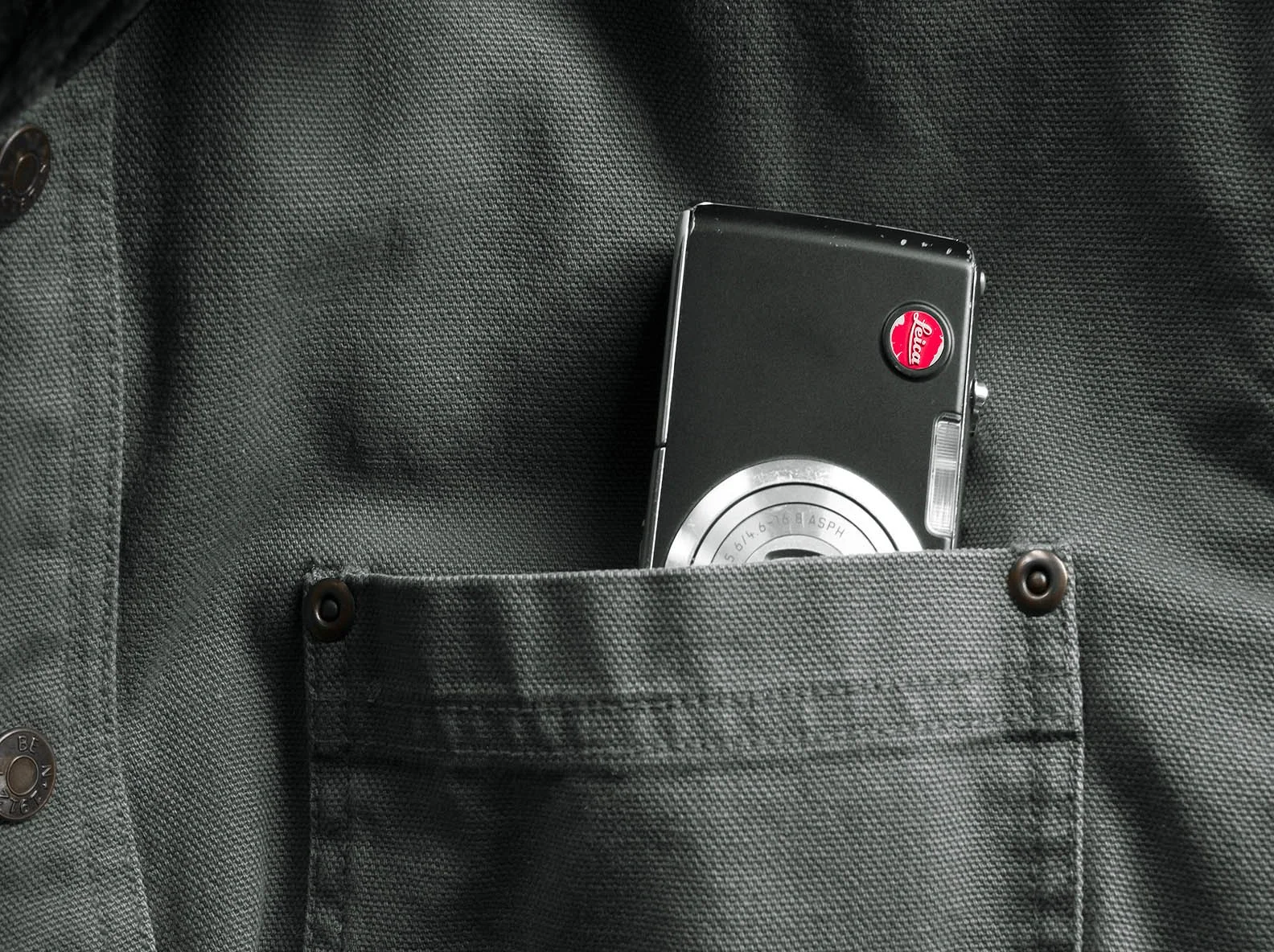
This C-Lux 1 is the only compact digital camera that actually fits into a shirt pocket. Even iPhones are too big for shirt pockets now. I really miss this small size.
I got my C-Lux 1 in 2006, just a few years after the Nikon D100 was released (which as we recall, was the first affordable DSLR camera from 2002), and both were 6.1 megapixels. This was a few years before the iPhone was released. This is an astounding feat of engineering when you consider the full sized Nikon D100 DSLR. I was seriously impressed and bought the C-Lux 1 a few moments after the salesman showed me the main features at Idaho Camera. He was impressed with how fast I made up my mind, but I was the one surprised at how incredibly small, full featured and cleanly designed it was. This was also when there were hundreds of small digital snapshot cameras being released every month. Never ending waves of them. Film was done for and I worried about it because of the magic of what happens when talented people interact with a manual process to get their own looks.
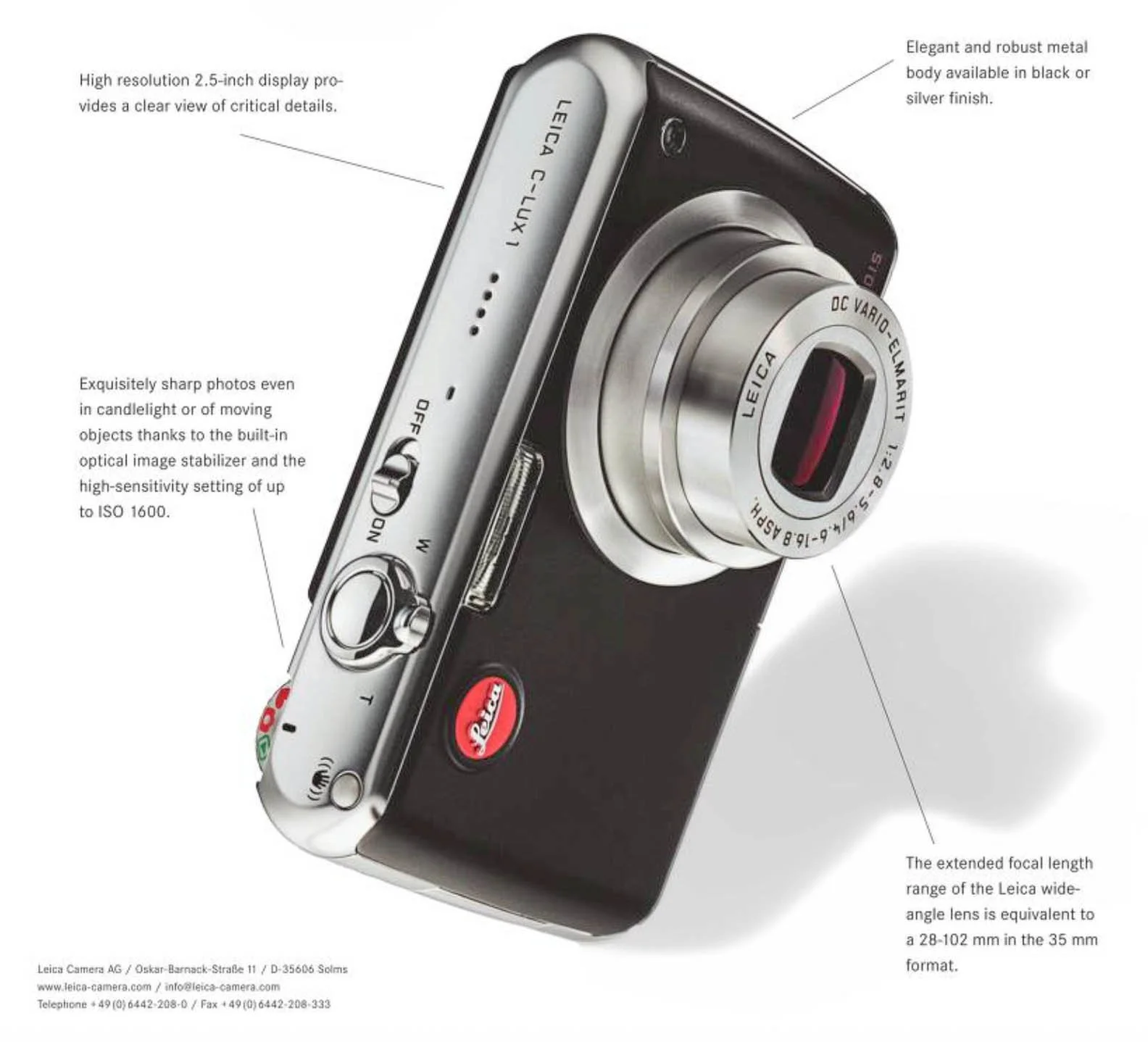
This is a photo from an early brochure and what it doesn’t show is how tough it is; mine has been dropped on concrete and just keeps on shooting. I still love how Lecia eliminates the extraneous from their designs. Keep making them simple and ergonomic. Nice going.
The Leica C-Lux 1 has a 28-102mm zoom, which is what we seasoned photographers call “the holy trinity of lenses” which is three prime lenses, a wide, normal and short telephoto. Generally 35, 50 and 90mm non-zoom lenses. The saying goes, “If you can’t make good photos with the holy trinity, it’s not the lenses, it’s you.” It is a Vario-Elmarit German lens design made by Panasonic. The aperture was a fast f/2.8 on the wide end and f/5.6 on the long end. Again, impressive. The zoom setting was right on the shutter button, which made for fast shooting. The lens fully retracts into the body when you turn it off to make it a completely flat camera.
It goes from ISO 80 to 1600, not bad for 2006 and far better than film, which still had a better image quality than digital cameras at the time. Film was in for a rude awakening though, because the moment a digital camera could make a high quality 4x6 print, there was no longer any reason for amateurs to buy film. This is because 4x6 prints dominated amateur photography, and amateur photography dominates photography (then and now). Millions of amateurs made 4x6 prints at One-Hour Labs all over the world each day. Part of the global culture involved bringing a roll of film into the lab and getting your prints back an hour later, not in weeks as when I was a kid. This was a daunting culture for digital photography to meet, and nobody would’ve guessed that the culture of photography would shift to digital photography in just a few short years. At any rate, this C-Lux 1 could meet the 4x6 photo quality and is what helped doom film photography. When I use this camera, I don’t think of anything as momentous as the end of film photography, I just think about how fun and easy it is to make good quality photos.
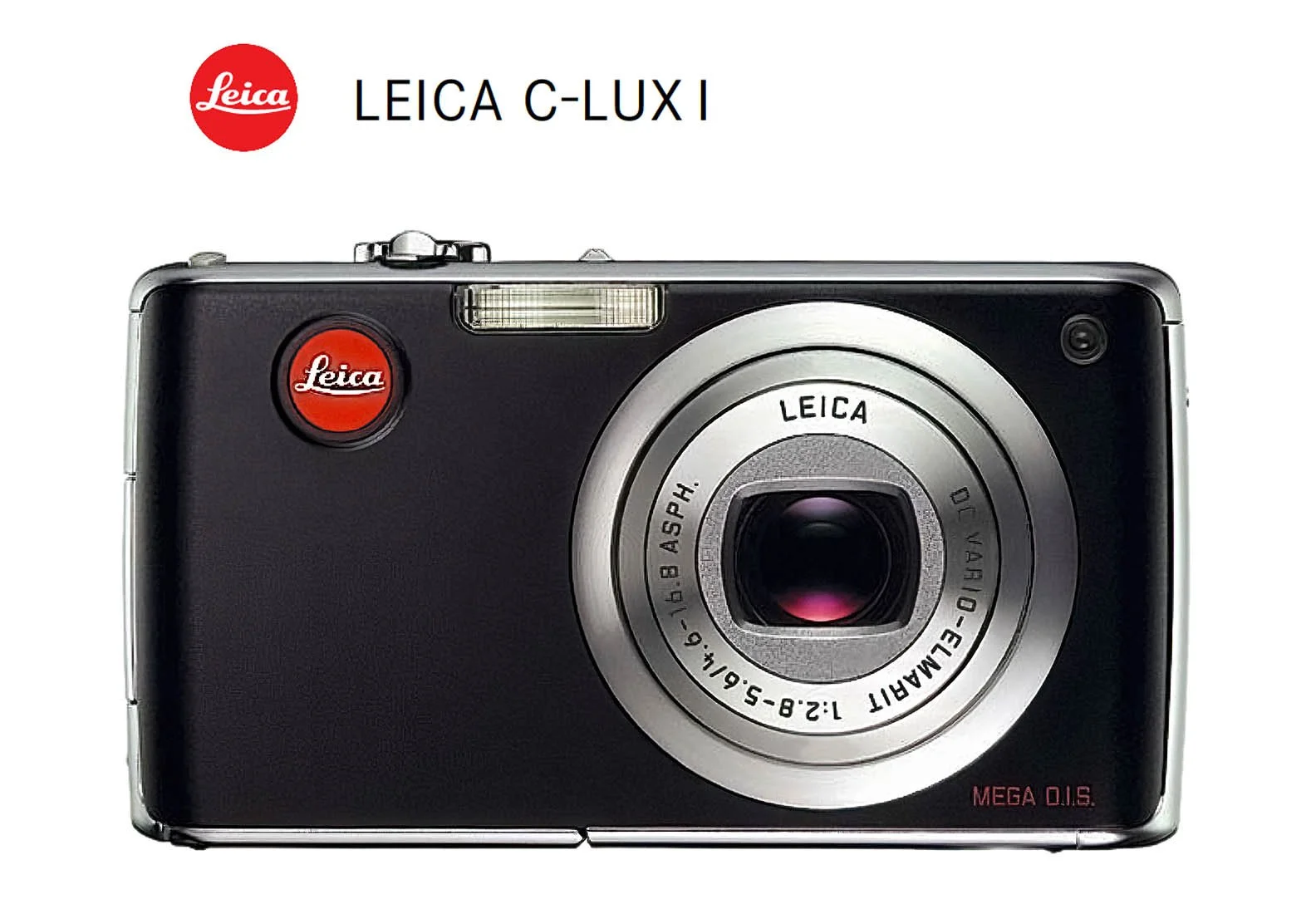
This is another photo from their brochure and what struck me about it was I could use it as a family snapshot and travel camera. Just pull it from your pocket and capture those fast elusive shots that usually get away because you don’t have your camera with you. It is why I was able to make so many photos with it over the years, I always had it in my pocket, especially when traveling fast when packing along a camera was sometimes cumbersome.
A most useful feature on this cool C-Lux 1 is the exposure compensation dial which becomes fast and intuitive and goes in 1/3 stop increments from -2 stops to +2 stops. All this means is you can make the photos lighter or darker as you’re composing the photos. This made for correct exposures “in camera.” A big deal if you don’t really care for fussing with image corrections in Photoshop or Lightroom later. The internal image stabilizer allows for shooting in dim light and I could hand hold exposures for up to half a second and still have them sharp. Shooting without a tripod in dimly lit streets is a great feature.
As a film photographer for decades, my preference is shooting in aperture priority mode so I can control the feel of the photo. Shoot at f/8 for better all-around sharpness and at f/2.8 for better blurred backgrounds. The only thing I’d have changed with this camera is to use a non-slip finish. I used my C-Lux 1 for a number of years (even after the D-Lux versions were released), and by then I’d accidentally dropped it a few times, even though I’m careful with cameras. By seven years later I was still using this phenomenal little camera which had racked up 1,180,523 exposures on it. Over a million photos shot. I’d worn it out and the zoom lever went first. By then I’d gotten the D-Lux 5, which had better features, but was also a little larger too. I wonder if Leica could fix this camera and get it running again?
After shooting over a million photos on this C-Lux-1 I also realized that this is really as small as cameras should get because smaller cameras become overly fussy. During Covid in 2020 I went online and found a mint condition C-Lux 1 and bought it because I wanted to see if it’d compare to today’s digital cameras. It holds up as a 6 megapixel camera, certainly way better than what any new iPhone photos can make. That’s the kicker for me, whether the C-Lux 1 may make better photos than an iPhone camera (because they’re both small and fast) and the answer is not just yes, but heck yes. The most important question is whether it may still meet my ongoing path with photography.
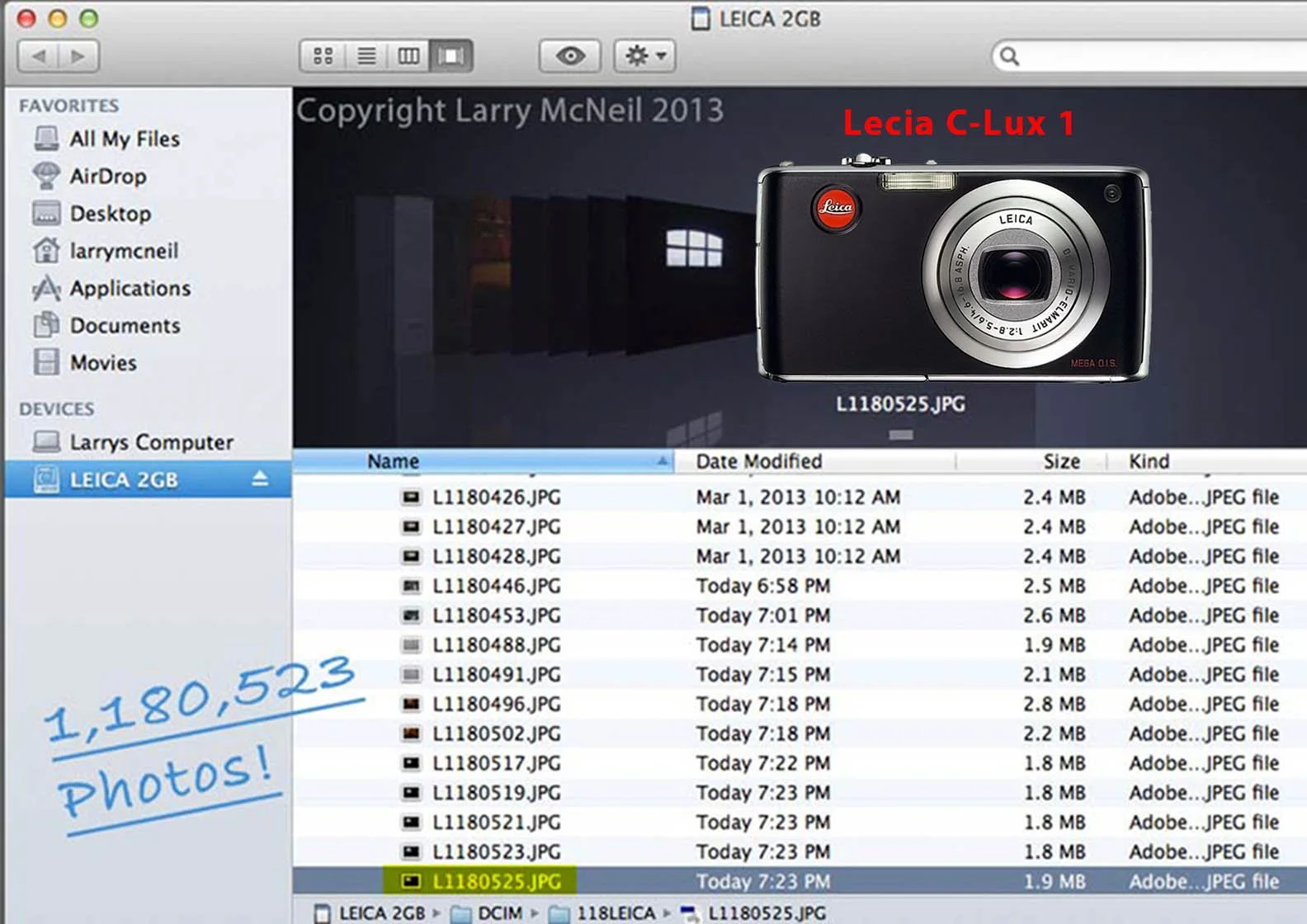
This was a screen capture of my laptop from 2013 and it shows that I was still using the cool little C-Lux 1 long after many people would’ve shelved it.
The ongoing Leica ethos is to design cameras that are simple and fast to use with maximizing the photographer’s talents and tech abilities. This C-Lux 1 set the stage for clean and thoughtful controls for both the camera and menu items. After all, simplicity of design is what made Leica’s reputation, along with impeccable builds that stand up to the rigors of professional use. Come to think of it, amateurs are pretty rough on cameras too. At any rate, the best cameras are the ones that stay out of the way and become a part of how you think and imagine, which is what Leica has always been about. My most recent mirrorless Leica has been the mighty Q2M Monochrom, a b&w camera that is the first digital camera to match the look and feel of sharp film negatives. Lots of us have been waiting 25 years for this camera to appear and who’d have guessed it would’ve taken this long? I can see the C-Lux 1 DNA in the Q2M, they share the same philosophy of simple designs coupled with making high quality photographs. And that is just plain fun, especially here at the Leica 100th Anniversary mark. By the way, I still shoot with my Leica IIIF made in 1955 and Leica M6 made in 1986. I’ve always loved rangefinders, but that’s another story.
If I could have a dream fulfilled it would be to have a full frame sized sensor built into a camera the size of this C-Lux 1. Hey, we can always dream, right?
Story Copyright Larry McNeil 2025, All rights reserved.